This month I’m moving right across the Roman empire, over 1500 miles due south to Hispania Baetica (nowadays known as Andalusia). Our plan was to visit family and friends, and enjoy some late summer sun. Son Daniel and his family now live in Málaga, where we began our trip on 3rd October; we ended it with a wonderful extended lunch in pretty Mijas with good friend and fellow Roman author Alistair Tosh, and his lovely wife Jenny. Ali is the author of the Edge of Empire series set in Roman Britain. He’s now writing a new trilogy about the second Punic War, for Sapere Books.
In between we spent a week on a hired Triumph Tiger motorbike, exploring the south-east of Andalusia. Now comes the disclaimer: this post is not about Roman Britain, and as you’ll discover, not entirely about the Romans in Spain. As we travelled, we went further and further back in time – all the way back, discovering what is now thought to be the most ancient continuously inhabited city in western Europe.
But we begin in Málaga, or Malaka as it was called by its Phoenician founders. The Phoenicians were of course legendary traders and colonisers, who founded this trading port on the western Mediterranean in the 8th century BC. Their cousins the Carthaginians followed, running the increasingly prosperous city till they lost the Punic Wars to Scipio Africanus in 218 BC, when Malaga and later all of Spain became Roman.
Roman theatre in Málaga; Punic warrior helmet; Carthaginian amphora.
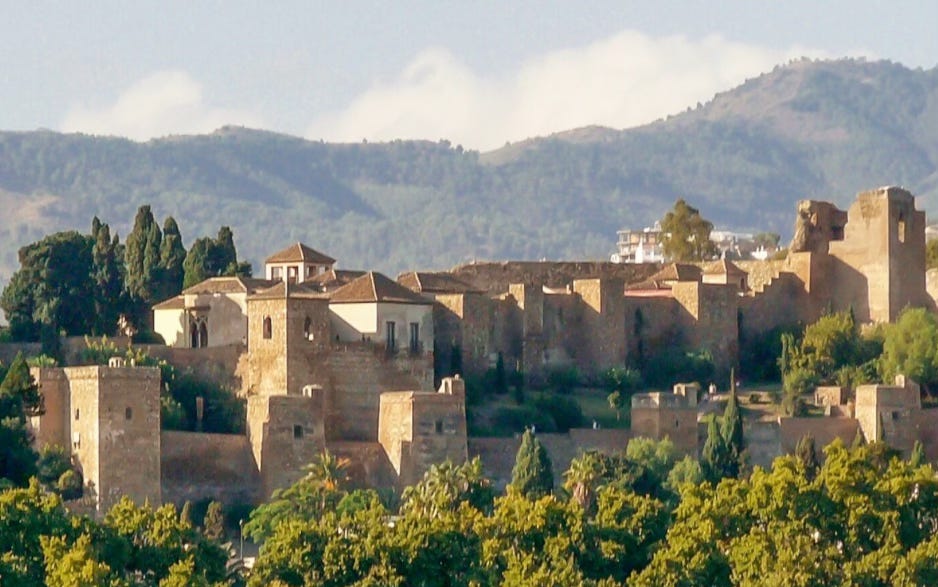
From Málaga we went uphill and inland to Antequera [in feature image]. In terms of overall longevity, Antequera has a good claim to be a winner, as we discovered when we visited the UNESCO World Heritage Bronze Age dolmens. They are oriented for viewing sunrise at the solstices over a nearby anthropomorphic landscape feature, La Peña de los Enamorados. The engineering and construction skills needed to build these dolmens over 5.500 years ago are truly staggering.
Antequera later became a Roman town (of course), then changed hands through Visigothic and powerful Moorish rule, till the 15th century reconquista.
La Peña seen from the dolmens; inside the Bronze Age dolmen; the Alcazar
I’ve written a lot more about the Moorish and Mudèjar towns we visited in my sister travel blog . For now, let me take you further into pre-history, to the magnificent city of Úbeda. This was furthest point of our short trip, a city we know and love from a previous trip in the Noughties. It was then most famous for its wonderful Renaissance architecture, having been largely rebuilt during the time of Charles V, cousin of our very own Catherine of Aragon. By that time, Úbeda had already been Iberian, Carthaginian, Greek, Roman, Visigothic, becoming the major centre of Ubbadat Al-Arab, and then the border (in the upper Guadalquivir valley) between the Moorish kingdom of Granada, and the Christian kingdom of Castile.
We came back to stay two nights because of a pioneering extended programme of archaeological research here, revealing that Úbeda has been occupied – without interruption – from the Copper Age to the present day. That is a period of six thousand years. During all that time people lived here, initially to farm, create copper metallurgy, and thrive, on the very spot where the Moors built their citadel in the 8th century AD, and now archaeologists continue to dig. This UNESCO city stretches our understanding of urban life back into the mists of time.
map of Úbeda; Cerro de Úbeda, view over Guadalquivir valley; Renaissance palacio; remaining Moorish wall; Italianate buildings
Guest author blog – Ben Bergonzi
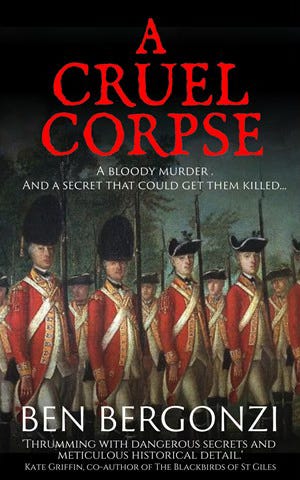
I’m so delighted to introduce you to Ben Bergonzi. Ben is known thoughout the historical fiction world as Reviews Editor for the Historical Novel Society. Now he’s taken the next step with his debut historical crime novel, A Cruel Corpse. Published by Holand Press, the fast-paced tale of murder and danger in 18th century Carlisle is out now in paperback and ebook.
Here is Ben in his own words about his novel’s background:
Visiting a regimental museum over 10 years ago, I happened upon the historical figure Hannah Snell, a British female soldier in the 1740s. Thinking of the genre of historical crime, I conceived of a female detective who could adopt either male or female roles at will and so use her disguises to investigate crime. She would be a soldier called Hayden Gray (because Hannah Snell used the name James Gray). Confident in her deception, she would say, ‘No-one sees past the uniform.’ Hooked by this notion, I researched other female soldiers and sailors who confounded the era’s rigid division between male and female, and all its rules of rank and behaviour. I found there were several cases of women who wore breeches every day, and were more or less believed to be men. After all, the eighteenth century was the one time when men were invariably clean shaven and either wore their hair long or used wigs.
Having tested Hayden out in a short story which did well in a competition judged by the crime writer Howard Linskey, I then sat down to write the novel. I had to go through several iterations of voice and backstory before I could start on page one with both my female soldier on duty in the army and with the murder victim already dead. To solve his murder, she has to turn detective so as to protect her own secret. I ‘trickled in’ her backstory via flashbacks, helped by the decision, in rewriting, to depict important scenes from other characters’ viewpoints.
I took from Hannah Snell’s biography the city and castle of Carlisle, an isolated setting and one which, as my story starts, is still recovering from having been the only English city occupied by Jacobites in the 1745 Rebellion. The postwar setting, of garrison soldiers suddenly at peace but falling out amongst themselves, appealed to me with memories of the great book and film Tunes of Glory.
And so eventually, after years of work and many doubts, I arrived at my first published novel (there have been others.) A Cruel Corpse as finished is not a discussion of transvestism, nor indeed a book solely from the female point of view, but is a crime novel first and foremost. I think the eventual outcome is suspenseful, vivid and reasonably fair to the history.
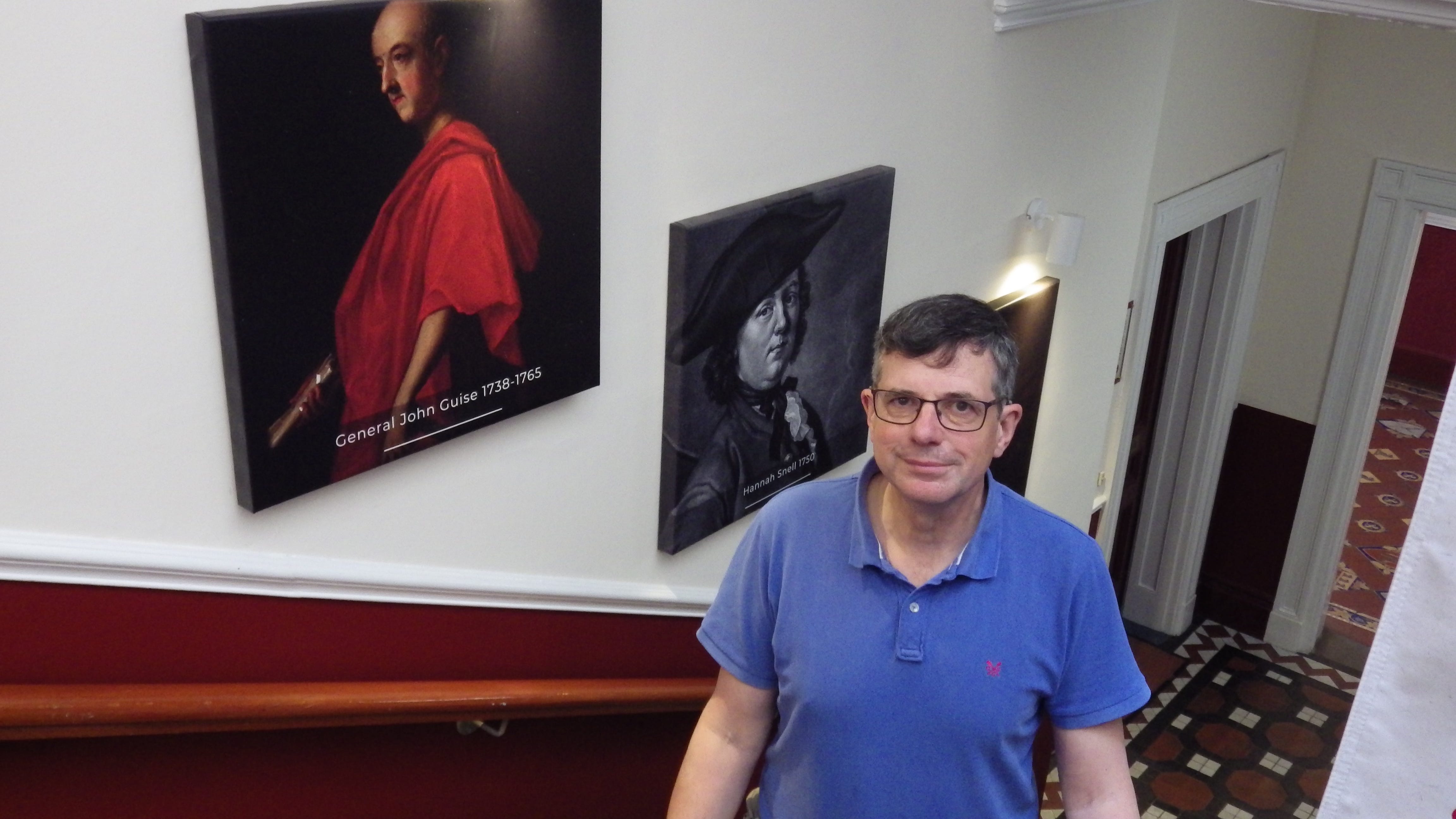
[Ben with the Colonel and Hannah]
About the Author -Ben Bergonzi
After a varied career in education and heritage, including spending time as a museum curator and as a manager of historical document digitization, Ben now works mainly as a reviewer and writer. He is a Reviews Editor for Historical Novels Review. Born in the north of England, he has spent most of his life in the midlands and the south; currently he lives with his family on the cusp of London and Chiltern Hills. His days as a re-enactor are long behind him, but he often remembers them while writing.
Jacquie’s October News
16 October: Tregolls Lodge Book Club
It was such a pleasure to revisit my friends at Tregolls, by the magic of Zoom. They really turned out for me, very flattering. One day I hope to visit in person, but the trek down to Cornwall is longer than I can do just now! I spoke about how I came to write my historical fiction, and was rewarded with an enthusiastic reception and interesting questions. Thank you, Tregolls and your indefatigable book club organiser, Howard Embery.
Jacquie’s published books, short stories, magazine articles, social media, and Youtube videos can all be found at her Linktree.
Thanks for reading Writing Roman Britain by Jacquie Rogers! Subscribe for free to receive new posts and support my work.




Absolutely gorgeous pictures, Jacquie!